
Tuesday, May 31, 2016
Monday, May 30, 2016
Make Us Bold in Loving
MEMORIAL DAY 2016
A Prayer at Evergreen Memorial
Cemetery
Santa Cruz, California
Dave Grishaw-Jones (Peace United Church)
God
of wind and fog, Spirit in great green trees,
Holy
Spark of Life in every being and, yes, Being itself:
We
praise you, we thank you
for
this holy place of resting and remembering and being.
We
praise you, we thank you
for
the beauty here, and the peace here,
and
for all those friends who’ve worked tirelessly
through
the years to make it a place
of
resting and remembering and loving.
We
gather here this sweet May morning,
and
we know that this is holy ground.
God
of our ancestors, God of all ancestors,
God
of the tribes and nations and wise souls
who
have called this very ground sacred and holy:
We
remember today all those who have lived
and
served and given their lives that peace might prevail.
We
gather them up in our hearts, in our memories now.
We
thank you for their courage and devotion,
for
their lives and their hearts and their holy days.
God
of all peoples, all the peoples who ever were,
and
all of us now, and all the peoples who ever will be:
We
pray today for grace, for humility and for courage.
We
pray today for the nation we love,
for
our leaders, for our public servants of all kinds,
for
our teachers at all levels, for all of us together.
Make
us bold in loving one another.
Make
us brave in serving one another.
Make
us wildly creative in pursuing the common good.
God
of the living and the dead,
Help
us in all things to honor those who’ve died,
Those
who’ve made loving sacrifices of many kinds.
Help
us to honor their gifts
as
we teach our children the things that make for peace.
Help
us to honor their lives
as
we show our children the sacred good in all beings.
Help
us to honor their spirits
as
we sing our children love songs
that
bring hope to their human hearts.
We
pray in your great spirit,
We
pray in your many, many names,
We
pray in humility around all we cannot know for certain,
And
we pray in commitment to the holy ground
and
the holy memories and the holy lives
we
remember this day.
Amen
and amen.
 | |
| Great-Great-Grandfather John H. Woodbury, killed at Spotsylvania, May 19, 1864. |

Friday, May 27, 2016
Monday, May 23, 2016
Clinton, Obama and Leadership

Reading Clinton's letter on the eve of the Methodists' gathering, I'm reminded (in an eerie way) of Obama's decision to distance himself from Jeremiah Wright and the UCC in 2008. It seems that she's doing the same thing here, for the same reasons. Supporting legitimate Palestinian aspirations (a state of their own, or simply human rights within Israel) brings little or no political benefit to a major-party candidate. The slightest critique of Israel is devastating. So both Obama (2008) and Clinton (2016) basically disavow the peacemaking prophets in their own faith communities to do the expedient and politically advantageous thing.
Why are things in the Holy Land so intractable? Well, there you have it. No US leadership (or courage) of any consequence.
Saturday, May 21, 2016
Taking It to the Streets (Festival Day 4)

PASTOR MIKE
Pastor Michael McBride has a gentle, open face, and a sweet way about him. But he’s a Pentecostal preacher to the core, steeped in the power of words; and, yesterday in Louisville, it didn’t take long to get "Pastor Mike" going. “We need our own campaign,” he said, not so subtly referencing the candidate addressing the NRA just across town. “But ours is undeniably a campaign for peacemaking and justice.” If the other campaign relies on fear and bigotry, the justice campaign is to be built on love and courage. “To do so,” Pastor Mike urged, “is to make love both the subject and the verb, both the instrument and the practice, of our campaign.”
Yesterday, this Festival of Faiths explored the movement known as Black Lives Matter. It wasn't easy. Not now, and not with the NRA in town. Fifty years after Selma, activists question America's intentions and the church's resolve. How can it be that a nation so
enthusiastically religious continues to embrace racist politicians and economic
apartheid? How can it be that religions
of peace so easily sanction gluttony and violence? Questions hung like bodies on crosses.
One speaker quoted James Cone of Union Seminary, who's suggested of late that "discipleship for whites in America means dying to whiteness." Another referenced the young Ferguson activist, organizing in the street, who insisted that "what we need now is not allies, but accomplices." With my eyes and ears I recognized these voices, appreciated them, honored them. In my heart I ached. Does it have to be so hard?
And of course, it does.
What a powerful, provocative day. Louisville may not be the “buckle” of the Bible Belt—but it's got to be close. I shivered in appreciation of the bold preachers, daring imams and thoughtful rabbis on stage. Pastor Mike (Michael McBride of the Way Christian Center in Berkeley) noted that Martin Luther King once diagnosed America as the most violent force on the planet; and that was fifty years ago. Before Iraq and Ferguson. Before Reagan's Contras and Cheney's waterboards. Then Pastor Mike asked leaders in the room a troubling, but essential question. “Will we decide to be chaplains to a failing empire?” he asked. “Or will we be prophets in a moral and spiritual revolution?” Sounds like a straight-forward choice. But is it really?
 |
| Pastor Michael McBride |
The project begins by reckoning
faithfully with history, and hearing particular voices, voices of the beaten and captive, voices of the fleeing and frightened. Trayvon Martin must be heard. Michael Brown must be heard. Jessica Nelson must be heard. Their parents and friends must be heard. Only then will Black Lives Matter. Only then will redemption be at hand, for all of us together. And the project meaningfully engaged.
Justice
is what love looks like in public.
Cornel West
Just then,
Pastor Mike spoke directly and prophetically to the church. “Faith formation,” he said, “is
underdeveloped in the Christian west, insufficent and hollow.” Love remains a romantic aspiration, “a
me-centered position,” rather than a “we-focused practice” of discipleship and
beloved community. “We’ve just got to do
better,” he cried, with love in his bright eyes, and all over his face. Faithful reckoning with American history moves disciples and accomplices on the 'way of the cross.'
TAKING IT TO THE STREETS
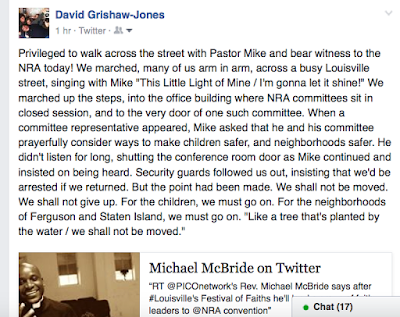
Later--after the workshop, after reciting the names of Michael Brown and Trayvon Martin and Jessica Nelson--Pastor Mike gathered twenty of us in the festival
lobby. There we linked arms, sang “This Little Light of Mine,” and followed our Pentecostal prophet quite literally into the street. We were Jewish and Christian, Muslim and agnostic. And our motley crew crossed four lanes of one-way traffic
and followed Pastor Mike into the office building where NRA committees were just then sitting in
closed session. Arm in arm, we climbed a
central stairway. Arm in arm, we marched
down the long hallway. Everywhere I go, I’m gonna let it shine. And when Pastor Mike reached the
NRA’s closed door, he knocked on it.
A stunned
representative appeared shortly. Mike
asked to speak to the committee and was told that wouldn’t be happening. Instead, he spoke directly and respectfully
to the still stunned NRA representative: “We just want to offer some faith-filled recommendations to the NRA, how to save more lives, to keep our communities safe.” When the representative turned to leave, Mike continued. "Many of us are working on many strategies to make us safer. So part of what we'd like to do is just ask that the NRA consider life-saving strategies and endorse them. We know that there's resistance to common-sense gun laws, like background checks, but there are many other strategies you could pursue." As the bewildered NRA leader looked around, Mike urged his NRA to consider safety features to protect kids and to divest from prison-for-profit corporations.
At this point, the committee member slipped back into the conference room, closing the door behind him, and in Pastor Mike's generous, loving, courageous face. Mike continued, naming the values we shared in that march, and our intention to continue working and organizing and struggling for justice and peace for our neighborhoods. When we left the building, two young security guards eagerly pursued Pastor Mike and let him know that he was no longer welcome in the building, and that he'd surely be arrested if he returned a second time. "We've done what we came to do," the Pentecostal peacemaker said without malice or disappointment. "We've done what we came here to do."
All last night, I wondered about Pastor Mike's critique of formation in the church: that it's "underdeveloped," that we don't build courage in our people, that we have so much more to do. As disciples and accomplices 'on the way.' What a gift he gave us all, in showing us what he's talking about! What witness he offered in taking us to the streets, turning ideas into actions, bringing light to darkness and carrying himself (and us) with such dignity and grace. What will it take for the Christian church--around the country--to shape lives, and build communities, capable of such things?
Here's how I see it, after a long night of prayer and restlessness. Without a robust commitment to formation in the 21st century, churches ask too little of their members (that is, of disciples) and allow an anemic gospel to claim Christian lives and minds. An "underdeveloped" faith is satisfied with kindness, whereas Jesus insisted on release for the captives and comfort for the afflicted (Luke 4). An "underdeveloped" faith is satisfied with forgiveness, whereas Jesus insisted on reparation (Isaiah 58), reconciliation (Luke 15) and holy celebration. An "underdeveloped" faith is satisfied with peaceful living, whereas Jesus insisted on inner disarmament, active nonviolence and compassion. See the difference? An "underdeveloped" faith acquiesces to dominant cultural paradigms, expectations, even religious passivity. But Jesus said, "Take up your cross and follow me."
And South Africa's revolutionary work, its prophetic work, begins for Allan Boesak in the widow's prolonged and agonizing cry--in the nation's "reckoning" with her cry and her loss. Her human cry, her humanness, and her human loss. Her pain--she insisted on this that day--must be heard by the oppressor, by the culture: not as an "issue" or a problem to be fixed, but as pain itself. Pain itself, hers, must now be reckoned with. (This, it seems to me, is something like the Black Lives Matter project now. Pain, reckoning and justice. Real, radical and revolutionary.)
For those of us hanging on in the Christian church, in the Jesus movement, this hermeneutic does two things. First, it RECKONS with history, and then it FORMS a people, a beloved community capable of courageous love and merciful justice. We read scripture, we wrestle with ancient texts...in order to RECKON with history from the vantage point of God's mercy and justice...and in order to FORM ourselves into the servant church, the called-out, shook-up people of God. Taking it to the streets.
 |
| Beat swords into ploughshares? |
At this point, the committee member slipped back into the conference room, closing the door behind him, and in Pastor Mike's generous, loving, courageous face. Mike continued, naming the values we shared in that march, and our intention to continue working and organizing and struggling for justice and peace for our neighborhoods. When we left the building, two young security guards eagerly pursued Pastor Mike and let him know that he was no longer welcome in the building, and that he'd surely be arrested if he returned a second time. "We've done what we came to do," the Pentecostal peacemaker said without malice or disappointment. "We've done what we came here to do."
All last night, I wondered about Pastor Mike's critique of formation in the church: that it's "underdeveloped," that we don't build courage in our people, that we have so much more to do. As disciples and accomplices 'on the way.' What a gift he gave us all, in showing us what he's talking about! What witness he offered in taking us to the streets, turning ideas into actions, bringing light to darkness and carrying himself (and us) with such dignity and grace. What will it take for the Christian church--around the country--to shape lives, and build communities, capable of such things?
Here's how I see it, after a long night of prayer and restlessness. Without a robust commitment to formation in the 21st century, churches ask too little of their members (that is, of disciples) and allow an anemic gospel to claim Christian lives and minds. An "underdeveloped" faith is satisfied with kindness, whereas Jesus insisted on release for the captives and comfort for the afflicted (Luke 4). An "underdeveloped" faith is satisfied with forgiveness, whereas Jesus insisted on reparation (Isaiah 58), reconciliation (Luke 15) and holy celebration. An "underdeveloped" faith is satisfied with peaceful living, whereas Jesus insisted on inner disarmament, active nonviolence and compassion. See the difference? An "underdeveloped" faith acquiesces to dominant cultural paradigms, expectations, even religious passivity. But Jesus said, "Take up your cross and follow me."
THE WIDOW WHO WAILED
Which brings me back to the Rev. Dr. Allan Boesak and his story about South Africa's Truth & Reconciliation Commision. The context, I think, was Dr. Boesak's reflection on oppression and grievance, cheap grace and reconciliation; and he was quick to say that the Truth & Reconciliation Commission did not set out to quickly or magically heal so many wrongs. No one can or should forget what happened in South Africa, to families, widows, children, and to the larger society of human beings as well.
 |
| Allan Boesak |
Still, choices have to be made: retribution, fierce contempt, truth-telling, faith. Choices. On Wednesday, in the Festival of Faiths' first session, Dr. Boesak told the story of one widow and her appearance before the Commission in 1996 or so. Her husband had been killed ten or twelve years before. And for the first time, this woman sat that day before representatives of her dear husband's brutal and racist murderers.
Dr. Boesak described the scene: how she leaned back in her chair and offered up her grief, fully and physically and powerfully. Such a cry as he had never heard. And two decades later, he called it a defining, even self-critical moment in the "reckoning" (that's Pastor Mike's word) of South Africans with apartheid, its terror and their history. The widow could not, and did not, expect to make things right that day, or to exorcise the past or her pain, or to bring back her murdered husband and the years lost. And that's not what "truth and reconciliation" is all about, either.
Reconciliation, said Allan Boesak, has to be "real" (and not some version of quietism), "radical" (and that means leaning into real justice, safeguarding human rights) and "revolutionary" (and that means transforming the person in relation to society, and the society in relation to the world). These three words are his: real, radical and revolutionary.
Reconciliation, said Allan Boesak, has to be "real" (and not some version of quietism), "radical" (and that means leaning into real justice, safeguarding human rights) and "revolutionary" (and that means transforming the person in relation to society, and the society in relation to the world). These three words are his: real, radical and revolutionary.
 |
| Enduring Witness |
Biblically, it's something like Hannah rising in 1 Samuel 1, and insisting that her pain be seen and acknowledged. "Look on the misery of your servant, and remember me, and do not forget your servant!" It's something very much like the Syro-Phoenician mother refusing to yield and insisting that Jesus' acknowledge her distress, her daughter's pain (Mark 7). Even after Jesus dismissed her out of hand the first time around.
With her prolonged, agonizing cry, the South African widow insisted on being heard and demanded true and meaningful reconciliation. Not some fairy tale ending. Not a quick and easy apology.
Here, then, is the hermeneutic for biblical faith: the widow crying out, wailing before her husband's killers in South Africa. She's insisting on something deeply, profoundly, theologically essential: meaningful reconcilation, gospel peace. Pastor Michael McBride said on Friday that "if there is no capacity to change, there are no subjects or verbs, there is no love." Gospel insists on such capacity, counts on it, waits for it if necessary.
For those of us hanging on in the Christian church, in the Jesus movement, this hermeneutic does two things. First, it RECKONS with history, and then it FORMS a people, a beloved community capable of courageous love and merciful justice. We read scripture, we wrestle with ancient texts...in order to RECKON with history from the vantage point of God's mercy and justice...and in order to FORM ourselves into the servant church, the called-out, shook-up people of God. Taking it to the streets.
Friday, May 20, 2016
Thursday, May 19, 2016
Good Religion?
Or is hate in your heart?
Out of love are you giving,
How will you play your part?
'Festival of Faiths 2016'
Pathways to Nonviolence
 |
| Roots & Wings, Louisville, KY |
During this afternoon's session, focusing ostensibly on "Islamophobia," Dr. Tori Murden McClure (President of Spalding University here in Louisville) decisively reframed the conversation at hand. To begin with, she (and others) tossed aside the term "Islamophobia" and insisted on anti-Muslim racism instead. They were resolute in making connections, distinctively American connections, between anti-Muslim racism and other pernicious forms. The subject, they said, is wrapped up in a package with the nation's history of genocide and enslavement, and with the nation's contemporary struggles as well (Black Lives Matters, most notably). Calling it racism makes these ties visible and unavoidably important.
Dr. McClure then reviewed just a bit of 21st century history:
+ That since 9/11, in the so-called "War on Terror," 1.3 million Muslims have been
killed (by fairly conservative estimates) and 25,000 Americans have been killed.
+ That since President Obama took office, American sales of military weaponry
overseas have more than tripled.
+ That fear clearly serves to obfuscate and delude, insisting on the hidden motives
and violent religion of the other, even as it hides the cruel and death-dealing
theologies manifest in our own national choices.
The problem, it seems so clear, is not the violence of Islam at all, but the insatiable violence and appetite of the American Empire. Is that going too far? Can we talk about the "American Empire" in this way? How else would one describe it? 1.3 million Muslim deaths (and, let's face it, the overwhelming number innocent civilians and vulnerable folk)!

While it's so easy for cultural elites (and Christians like me) to enter conversations like today's searching for clues to the crisis in Islam, or the violence of Islam, the more timely and honest questions revolve around American imperialism and the religious narratives that bolster and drive it. "Have you got good religion / Or is hate in your heart?"
Later, Linda Sarsour of the Arab-American Association of New York spoke honestly, and quite painfully, of her weariness as a Muslim and a mother and a American. She mentioned her three teenage children and her uncertainty as to what kind of country they're growing into. In talking about activism and interfaith solidarity, she was clear and prophetic. And she quoted an Aboriginal activist from Australia:
IF YOU HAVE COME HERE TO HELP ME,
I AM NOT INTERESTED IN YOUR HELP.
BUT IF YOU HAVE COME HERE
BECAUSE YOU BELIEVE YOUR LIBERATION
IS BOUND UP WITH MINE,
LET US WORK TOGETHER.
The day ended, on the big stage, with the gifted and spirited artists of Roots & Wings asking the only questions worth asking: "Have you got good religion / Or is hate in your heart? / Out of love are you giving? / How will you play your part?" The time has come, my Christian friends, to answer honestly and to speak prophetically and to stand in strong solidarity against the cold winds and hungry appetites of empire. Our liberation, after all, is at hand and bound up with Linda Sarsour's and Ingrid Mattson's and Imam Zaid's. Let us work together!
Subscribe to:
Posts (Atom)