Wednesday, August 30, 2017

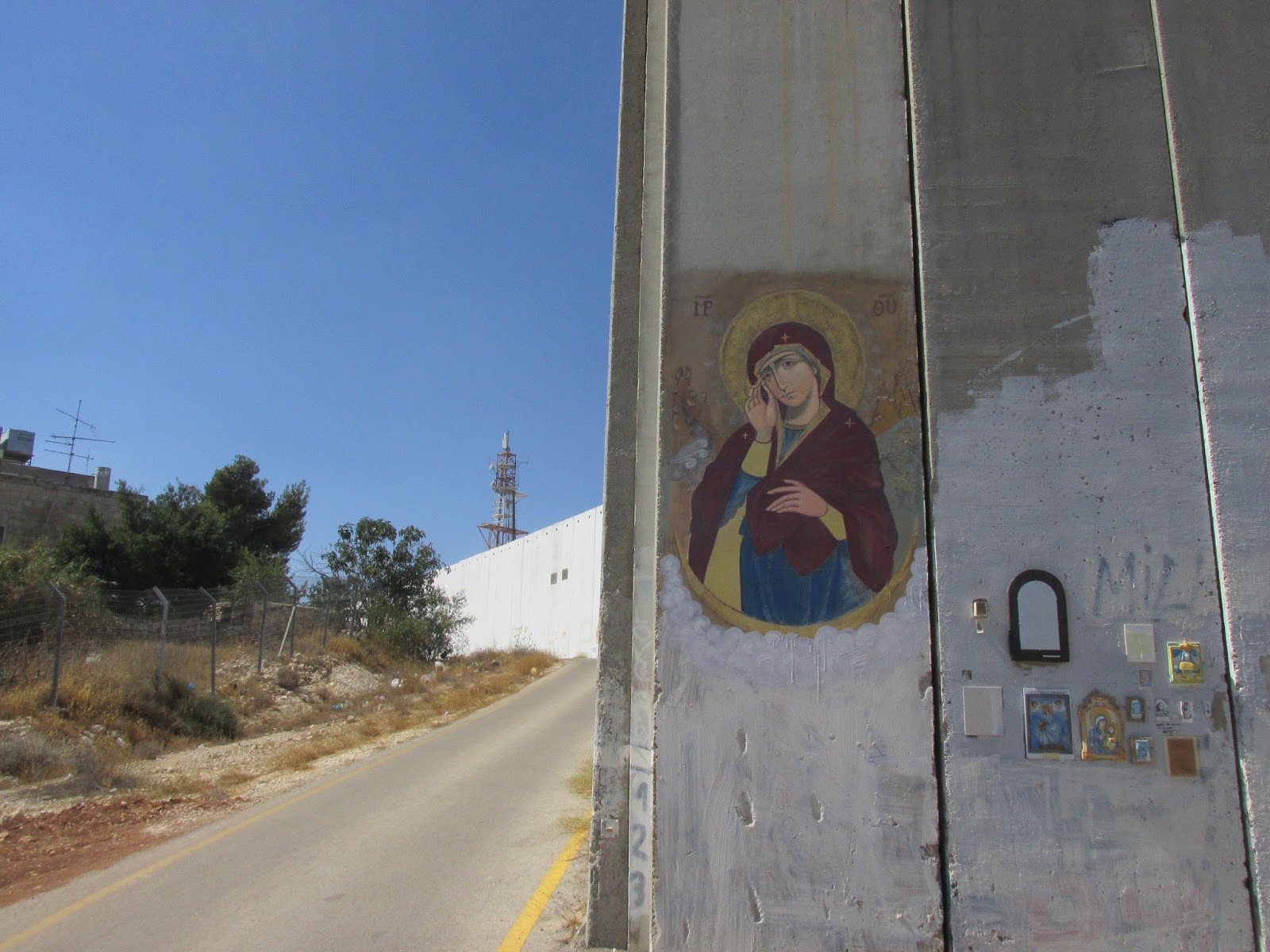
Our Lady Who Brings Down Walls

Icon of the Mother of the Church, written on the separation wall between Bethlehem and Jerusalem.
PRAYER TO OUR LADY
WHO BRINGS DOWN WALLS

Most Holy Mother of God,
We pray to you as mother of the Church,
mother of all Christians who suffer.

We beg you, through your ardent intercession,
to bring down this wall, the walls of our hearts,
and all the walls that generate hatred, violence,
fear, and indifference between people
and between nations.

You who crushed the ancient Serpent by your Fiat,
gather and unite us under your virginal cloak,
protect us from all evil and open forever in our lives
the gate of Hope.

Bring to birth in us and in our world
the civilization of Love that sprang forth from the Cross
and Resurrection of your divine Son,
our Lord and Saviour Jesus Christ,
who lives and reigns forever.  Amen.

Bethlehem Icon Centre


Tuesday, August 29, 2017

That They May Be One (Bethlehem)

The Separation/Apartheid Wall (Bethlehem)
We're greeted, at Wi'am, by the enthusiastic staff of a community 'conflict transformation' center.  I've known some of these Palestinian leaders for 9 years now, and their dedication to one another and the people of the West Bank shines bright.  It's particularly hard to be hopeful now, and here, but Usama and Tareq and Lucy and their colleagues seem to know that the alternative is untenable.  Hope is life itself here in Palestine.  Tenuous and precious.

An Arabic word, 'wi'am' means something like 'agape'--the New Testament word for the kind of love that transforms us and makes us human and whole.  In Arabic use,'wi’am' also means 'cordial relationships,' and developing relationships is the essence of the center's mission. Wi'am helps resolve disputes within the Palestinian community at the grassroots level by implementing the traditional Arab form of mediation, known as Sulha, along with Western models of conflict transformation. The center has programs that empower children, youth, women and men, addressing the psychological and physiological consequences of long-term conflict and occupation.
A Playground in the Shadow of the Wall
We eat lunch with the staff, looking out over the center's playground, noting the huge separation wall that rises above it.  Usama points to a huge rifle, fixed to the top of the wall, and tells us about the day this summer when Israeli soldiers turned 'skunk water' against the Palestinian kids in the playground.  Later, he shows us several raised beds built to teach basic gardening.  These were destroyed when soldiers opened sewage pipes in such a way as to inundate the fledgling seedlings.  These kids have no chance.

Just behind our lunch table, Usama points to a line of used tear gas canisters (most made in Pennsylvania, by the way).  These are shot, regularly, from atop the Israeli wall, along with rubber bullets the size of golf balls.  The point of all this seems clear: make life as miserable and intolerable as possible for children and families.  Make them give up and leave.
Tear Gas Canisters, from Playground
Raised Beds, Destroyed by Sewage

As Usama leads Fiona and me through the AIDA Refugee Camp, just a few blocks from Wi'am itself, I think about the work of these last two years: the BDS conference we planned in Santa Cruz; the controversy, criticism and heartbreak around it; the congregation's bold decision to become an "HP-Free" church; our efforts to link conversations about race and mass incarceration in the States with conversations around occupation, detention and apartheid here in Israel-Palestine.

This work has been some of the best, and most painful work, of my life.  Walking through AIDA, and then along the grotesque wall; picking up hard rubber bullets in this playground and tear gas canisters too--I'm more and more determined to continue.  I am invested in this mayhem, in this violence and in this conflict.  I'm not innocent.  In September 2016, my country committed $38 billion (billion, with a 'b') to Israel's military over the next 10 years.  That's my wall up there.  These are my canisters, my bullets.  And that 'skunk water' would be impossible without the support of my American empire.

My colleagues here--from Palestinian clergy to brave organizers like Usama--insist on solidarity and meaningful action.  To see apartheid (and take pictures of apartheid) but do nothing substantive, even small, is to participate, even to normalize this madness.  At least it seems that way to me.  Here, at AIDA.  And across this land.


MLK's Word on the Wall
The graffiti on this Wall is stunning, colorful, diverse.  Up ahead, I see an MLK quote, offered in East Berlin I think, many years ago.  "Here are God's children on both sides of the wall, and no man-made barrier can destroy this fact," King shouted.  "With this faith, we will be able to tear out of the mountain of despair a stone of hope."

This is the testimony of my Palestinian friends in East Jerusalem and the West Bank.  They are brave, brave souls.  And they believe--as King did 50 years ago--that no wall can destroy the unity God intends.  For Jew and Muslim.  For Christian and Jew.  For Palestinian and Israeli.  For all who ache for a safe, beautiful and radiant home.   What they tell me--and I believe them--is this: BDS is a key strategy for achieving such unity.  BDS offers hope, encouragement, partnership...as they do the hard work, "tearing out of the mountain of despair a stone of hope."  Critics in the States have loudly accused us of anti-Semitism, have vigorously critiqued BDS-advocates for "stirring" anti-Semitism and giving it power.

I wholeheartedly, respectfully and just as vigorously disagree.
"That They May Be One"
There is a very important and often obscured difference between anti-Semitism (or anti-Judaism) and criticism of Israel.  I'd go so far as to say that the most Jewish thing in the world these days is the action that critiques and subverts the occupation of Palestine and the shackling of Arab human rights on both sides of the Green Line.  What's more Jewish than human rights work?  What's more Biblical than the struggle for liberation from domination systems and bureaucracies of harassment and intimidation?  I have, thank God, met many Jews over the years--in the States and here in Israel--who do this work with gusto and with passion, and with a prayerful and humble heart.  In many ways, they are my heroes.

I will continue to join them in their efforts to call for human rights and full democratic participation: for Arabs in Israel, yes; and for Palestinians in every occupied place, yes.  If illegally settled Israelis can vote for their government, Palestinians a stone's throw away should also vote for that government.  If illegally settled Israelis can send their kids to schools that have running water and good teachers, Palestinian families should expect (and get) the same.  One civil society.  Human rights for all. 
Graffiti: Witness to the Palestinian Prisoners' Hunger Strike of 2017
Black (and Brown) Lives Matter
13 year-old boy in AIDA, who was shot and killed, from an Israeli sniper post atop the wall.
It's particularly sad, outrageous is a better word, that Israeli authorities are using Palestinian children in their ongoing effort to transfer (or demoralize) the Palestinian people.  We heard last weekend about the impact of detention and imprisonment on children and teens in Silwan.  Just this week, three Palestinian schools (funded by the Europeans, no less) were destroyed (as in razed to the ground) here in the West Bank.  Just two or three days before the new school year was to begin.  In what way is this justified?  In what way is there any spiritual or moral or even international sanctioning of this kind of behavior?  "Thou shalt not steal," right?  They're stealing childhood from these kids, and land from their families, and hope from their hearts.  

So don't tell me--or Palestinian parents--that the $38 billion aid package is morally justified.  And don't tell us to shut up and do nothing at all about it.  That same $38 billion would work very well, thank you, in Houston, Texas this week.  Or in so many American school districts where the teachers are underpaid and the textbooks outdated and the bathrooms rancid.

There's a wearied look in the eyes of all these folks: my Israeli friend who guides tour groups and loves her country and worries about the young daughters who'll soon be serving in the military; the Palestinian pastor who gives his heart and soul to each project, to each sermon, to each encounter; the Silwan activist who sees more and more kids arrested and detained and traumatized every month, and knows the whole point is to force these families to move somewhere else.  Even the cab drivers this summer seem defeated.

I can never know their pain.  I can never experience it.  What I can do is listen closely, and pay attention to their calls for support, action, solidarity.  I can take those same calls to heart, pray on my own capacity and responsibility.  And I do these things.  This is work, and this is witness, I am called to.  In the name of love.   That they may all be one.

Amos, Off Road

It's really quite simple.  Sometimes.  It's about light and dark, and the dancing of the two.  It's about dusty hills and gusty winds, and the impermanence of all of it.  And it's about people--from places like Bethlehem and Denmark, Santa Cruz and Connecticut--stopping long enough to recognize how holy it is.  The light, the dark, the dust, the wind.  And us.

Yesterday afternoon, our good friend Usama Nicola suggested an "off-road" pilgrimage, a journey into the high desert hills of the West Bank.  We'll see the Dead Sea, he said.  We'll watch the sun set, he said.  We'll eat dinner with the Bedouins.  Easy to accept an offer like that.
Jorgen and Usama, Sunset in the Desert
But it was so much more than a pilgrimage, a quick look at the Judean hills.  On our way, Usama pointed out the Palestinian village of Tekoa, a small community that once was home to the surly prophet Amos, who railed against militarism and idolatry and famously intoned: "Let justice roll down like waters, and righteousness like an everyflowing stream!"  Nearby, of course, is a larger (and illegal) Israeli settlement, also called Tekoa.  And this gives me pause: Would Amos have anything kind to say about the mean-spirited enterprise by which settlers take the lands of other families and deny those families basic human rights, democratic opportunity and hope?  Or what about Martin Luther King--who reclaimed Amos' prophetic word for a generation of Civil Rights activists in the 20th century?  Would King look favorably on the apartheid inflicted systematically on the Palestinian minority here?

Probably not.

Beyond Tekoa, we traded in Usama's comfortable Kia for a Bedouin LandRover.  Our driver navigated dried out river-beds, steep mountain hillsides, old camel trails.  The only settlers out here were foxes and ravens, and a long line of camels on the move.  We bobbed and bumped all the way to the steep cliffs above the Dead Sea, and then back to a special hillside as the sun set--gloriously, joyously, generously--in the west.  No checkpoints, no concrete barriers, no guns here.  Just light and dark, dancing.  And what a gift to share this desert sunset with my daughter Fiona, just days before she begins a third year of college!  What a pleasure to share it with Usama (in whom the spirit of Amos shines, even now) and new friend Jorgen Kvist Jensen from Denmark!  

These are painful, divisive, demoralizing times in Palestine, in Israel, among these peoples.  Almost everyone we meet is tired, weary to the bone, to the core.  But our weariness is not God's despair.  God shines like the desert sun, circles us daily, amazes human hearts.  And that dance is ours, if we want it.  "So let justice roll down..." 


Sunday, August 27, 2017

This Week in Jerusalem

Fiona and Parrot, Christian Quarter

Beam of Light, Church of the Holy Sepulcher

Morning at the Dome of the Rock

A Moment in Time

The Western Wall, Women's Side
"This Week in Jerusalem"

She's an atheist now, and she seems happy with that,
Wandering through this old city with her father, the pastor,
Watching earnest pilgrims pray at the old temple's wall,
And climbing the ramp that leads to Haram al-Sharif, to Al Aqsa,
And so many beautiful dreams and so much human grievance.

She puzzles when a Waqf official approaches, when he
Asks her to pull up her sweater, just a little higher,
So there's less skin showing here among the holy places.
Her question's a fair one: What does any god have against skin,
If it's skin god put all these humans in, to begin with?

We spend days this way, walking slippery streets of stone,
And commenting on the beauty of faces, and the colorful ways
Our sisters and brothers dress themselves and talk about food
And carry huge trays of bread on their lovely heads.
And she smiles in the churches, and she pauses at the wall.

She listens, close, when the Palestinian woman talks about the hurt,
And she laughs when another friend laughs at the crazy spirit
Of this place and how it would all be better if religion went away.

I'm not so sure about atheism as a thing, but that's just me.
It's always seemed to me that everybody believes in something.
And the gift of this week is hanging out with Fiona, my daughter,
Stumbling through Jerusalem, seeing what it is she finds important and good,
Cherishing what my girl, who's not a girl anymore, believes.

DGJ
Jerusalem, Sunday
August 27, 2017


Saturday, August 26, 2017

Existence is Resistance

Under steamy summer skies, Fiona and I found our way to Silwan this morning, a crowded East Jerusalem community just a stone's throw from the Al Aqsa Mosque and Temple Mount in the Old City.  In ancient times, pilgrims would wash in the pools at Siloam--deep in the valley here--before making their pilgrimage up the steep slope to the Temple.  Later, according to John's gospel at least, Jesus healed a man born blind here (John 9) in the same pools.  Today, Silwan is a Palestinian neighborhood, its families stressed by conflict with aggressive settlers, demolition orders and a handcuffed economy.  We got just a little lost, Fiona and I, before a generous man in the street redirected us.  You're looking for the Center, he said.  Up there.

We were encouraged by US colleagues to visit Sahar Abbasi at the Wadi Hilweh Information Center, founded a decade ago to help families meet the intense challenges of occupation, intimidation and police harassment.  Sahar's work with children and families offers support and encouragement in a climate of extreme frustration and despair.  Her people ache. 
Fiona and Sahar, by the Mural created by Silwan's Children
Sahar notes the disturbing presence, in these crowded streets, of ideological settlers, brazen religious folk with no interest in coexistence or mutual respect.  She describes police raiding Palestinian homes at 2 am in the morning, banging on Palestinian doors, terrorizing women, imprisoning children as young as 8 years old.  She tells us of mothers who have no idea where their children are taken, nor how to find out.  And she says it's only getting worse.  The level of frustration is rising fast.

I'm struck by Sahar's own frustration.  This is a decent, kind, soft-spoken and compassionate woman.  She devotes her waking hours to children and parents: imagining ways to support and encourage them.  She reaches out, gently and warmly, to each teenager arriving for the day's activities.  It's so clear that she cares--in a deep, spiritual, connected way--for these young people.  And.  And she's frustrated and demoralized.  The raids continue.  The arrests and imprisonment of young people continue.  Sahar understands--in a painful and brutal way--that it's a project of "transfer," an attempt to scare (frighten, terrorize, intimidate) her people into leaving their homes and homeland.  And how much can they take?  Where does this end?  Once they called the policy "silent transfer"--forced relocation through administrative policy--but there's really nothing "silent" about it now.  Nakba goes on here.  It's everyday life.

Out of a very deep place, Sahar smiles and says: "Violence will get us nowhere.  Violence will only come back to hurt my people and do us unimaginable harm."  And your alternatives? we ask.  "To survive," she says with hurt and pain beyond our imagining.  "To raise our children with dignity and art and love."  And then she offers the line I will take home with me and think on for days to come: "For us," Sahar says, "existence is resistance."  The municipality could care less about Silwan.  The municipality refuses to pick up their garbage regularly, refuses to provide meaningful education for their kids (40% don't have schools to go to).  The municipality engages in what can only be called "collective punishment."  So, of course, she's frustrated.  "Existence is resistance."  And then: "We will not be moved."

We shall not, we shall not be moved.
We shall not, we shall lnot be moved.
Just like a tree that's planted by the water,
We shall not be moved.

A Child's Rendering of Demolition, Occupation and Violence in Silwan
In the latest issue of "Tikkun," devoted to "Israel's Occupation at 50," Jonathan Kuttab sketches a vision of justice, reconciliation and democracy here.  It's a hard sell, perhaps, on all sides.  But Kuttab--a Palestinian attorney and human rights activist--knows what he's up against.

The article's available on line (with a subscription), though I'm moved to offer pieces of it here.  It may be the most hopeful piece I've come across in a long, long time.  Kuttab describes, in detail, the demise of the so-called "two-state solution" and the necessity of something better, something more visionary, something more enduring.  Here's how that works:
"The changes that were created by the settlement movement [after 1967, accelerating now] were sufficient to render the two-state solution no longer tenable.  The physical facts on the ground, the transfer of over half a million Jews into what was to be an Arab Palestinian state, the creation of an elaborate legal, administrative, psychological, and physical structure on the ground in the 'Occupied Territories' as well as the thorough integration of the Occupied Territories into the Israeli system, made such a geographical separation no longer feasible.  At the same time, it slowly became evident that despite the huge disparity in power between the two antagonists, neither side was going to disappear, and that a solution needed to be found within the unitary totality of the Land that accommodates both parties.  The attempt to fragment the Palestinian people into disparate and disjointed communities, while physically successful, has failed to obliterate their sense of identity as a people, or to dissipate their national ardor."
Wadi Hilweh Information Center, Silwan
"Facts on the ground" make a "two-state solution" unimaginable now.  Realities across the West Bank--where settlements expand month to month, year to year--make a "geographical separation" (Israel over here, Palestine over there) no longer feasible.  The many families of Silwan, the dear children Sahar loves and protects with every waking breath--these human beings must be full citizens in democratic system, a national project that honors their humanity and protects their human rights.  That project, that country has to provide an education for them, equal to the kids in other parts of Jerusalem.  That project, that country has to protect them against police violence, military over-reach and judicial malpractice.  Equality and democracy.  Only these can make Silwan (and Israel) safe and prosperous for Palestinians and Jews alike.  

Of the challenges and sacrifices required for peace, Jonathan Kuttab writes:
"Those who are willing in any way to step out of their narrative, to listen to, and attempt to, accommodate the 'other' rather than ignore, deny, attempt to obliterate, delegitimize, and demonize the Other are faced with a genuine need to adjust their own ideology to somehow incorporate, embrace, or at least account for the hopes, desires and aspirations of the other party."
This may be the most complicated (and impressive) sentence in the whole piece.  Am I willing to "adjust [my] own ideology to somehow incorporate...the hopes, desires and aspirations of the other"?  What kind of maturity might that require of me?  What kinds of sacrifice am I willing to make?  Can this happen here, where conflict runs so deep, where facts on the ground are so grotesque, where kids are taken from their parents in the dark of the night?

It's taken me a long time to fully grasp (not just a little, but fully) that the issue here in Israel-Palestine is not a religious one, not a matter of Jews against Muslims and Christians, not a matter of anti-Semitism or bigotry.  It's about justice and land.  It's about fear and class.  At some level, it's about race.  But it's not about religion and doctrine and three faith traditions at odds with one another.

Still, reading Kuttab's piece in "Tikkun," it strikes me that spiritual wisdom, religious wisdom may yet orient these decent people and their institutions toward justice.  For the great traditions of this land speak boldly of making sacrifices for the common good.  And they insist on respecting and even embracing the genuine humanness in the "other."  In fact, to be Jewish or Christian or Muslim comes down that that, I think.  Do we open the doors of our hearts, the windows of our minds, the gates of our homes to the "other," to the neighbor who worships in a different way, to the stranger who needs our generosity and compassion?  Do we love?  That's the fundamental question for a Jew, for a Christian, for a Muslim.  So maybe these ancient traditions can--somehow--offer hope and wisdom to those who ache for imagination and new ideas.  Will they sacrifice something...to see peace emerge in a new and unexpected form, in a new and reimagined land?
Art Center, East Jerusalem
"For Palestinians, this means that they need to radically alter their nationalism.  They will need to abandon their claim that Palestine is exclusively Arab ('Falasin Arabiyyeh') and their belief that Israeli Jews are nothing but foreign settler-colonialists who have no right to remain in their stolen homeland, with the exception of those 'Palestinian Jews' who were indigenous to the land from before 1948.  Their goal of the Liberation of Palestine (as opposed to Ending the Occupation) must now recognize that that in the liberated Palestine will live about 7 million Jews who consider it their home, and, liberation or not, their future state will have to be binational.

"For Israelis, the Zionist dream of a Jewish state will need to be modified to recognize, finally, that their state will have to accommodate a local indigenous population of almost equal number to the Jews, who will never accept permanent dispossession and disenfranchisement.  The Zionist dream, which fired the imagination of many Jews and non-Jews, will finally be forced to come to terms with a reality that massive military, financial, scientific and international power has failed to eclipse.  The Jewish state they attempted to create must somehow come to terms with the indigenous non-Jews inhabiting the Land.  They need to answer the query of whether a state can be Jewish and still accommodate and provide genuine belonging to non-Jews, or must it forever abandon the claim that they can be democratic, and progressive, while being a Jewish state."
Jonathan Kuttab's proposal demands the deepest kind of reflection, the most profound kind of courage--and it demands these things of all sides, all peoples in this holy and beautiful land.  It seeks not to shame one side or another.  It seeks not to re-litigate the past.  But it requires that Jews and Palestinians alike "account for the hopes, desires and aspirations" of others here; and therein lies the religious challenge, the spiritual opportunity and the political nub.  I pray--with all that I am, and with every fiber of my being--that these marvelous peoples can rise to that challenge.  That kind of rising will lift them all. 
Morgie and me.  August 2017.  Jerusalem.
And so I finish, for tonight at least, with prayer.  I pray for Morgie Morgenstern, my dear and trusted Israeli friend, whose Jewish roots run deep and whose faith cultivates more strength than I could ever hope for.  I pray for Sahar Abbasi, a new friend, a kind and determined leader in her Palestinian neighborhood.  I pray that these two women may someday meet, that they may someday build a country together and a future together, for all the children in their lives.  I know--in my heart, I know--that they would enjoy one another.  I know that they would respect one another.  And I know that what they want is the same: a country to call home, a Land to love and explore, a future free from tyranny and midnight raids.

God of our many contradictions, God of our hopes: bless these two friends with peace tonight, with a quiet rest and the deep assurance of grace.  Gather the children they love in your mercy and protect them from harm and injustice.  And rise with all of us tomorrow to build a better world, a more inclusive and just world, for all.  In this work, you will always be with us.  With Morgie.  With Sahar.  With us.  Amen and amen.


Friday, August 25, 2017

Praying is Like Playing Jazz

Tonight Fiona and I step inside, out of the summer heat, into a familiar place.  Kol Haneshama.  I've been to this synagogue several times over the past decade, and it has never disappointed me.  These people have never let me down.  Their music is sweet and rich with gratitude.  Their faces are bright with welcome.  Their faith, open to mine.

In the front pages of the synagogue's prayer book are the words of a recently retired rabbi:
"Praying is like playing jazz. The more you pray, the richer your prayer becomes. You can pray alone, but the exciting things happen with fellow pray-ers. It helps to know and trust the others, too (although you learn a lot when you pray with new people). Some services are traditional, others creative. Some synagogues are formal, others less so. The Jewish service is built around a set of spiritual themes. Sometimes we all pray in harmony, other times we each pray at our own rhythm, at our own volume.
"The siddur is a framework, like the page of notes in front of the jazz player. If you choose to use these words, know that if you read the prayers, you are not praying. One should try and reach a proper balance between the pray-er and the prayer, and between the pray-er and other pray-ers."
Tonight, in the back row, I'm thinking of the many "players" I know: Carolyn Wilkins in Cambridge and Lori Rivera and Art Alm and Brad Hecht and Dayan Kai in Hawaii and Steve Uccello and Stan Poplin and Zack Olsen and Renata Bratt.  I'm reminded of the "exciting things" that happen when we pray (and play) together.  The temple we create, in time.

I'm also aware, especially here, in this city, of the prophetic dimension: how peacemaking, too, is like jazz; how social change requires improvisation and discipline at the same time.  I'm aware that agitating for justice (Black Lives Matter, ecojustice, all of it) is most effective, most transformative when we play together and pray together and find the balance between one and all.  "Sometimes we all pray in harmony, other times we each pray at our own rhythm, at our own volume."

With this sweet community of Jews, we welcome Shabbat and give thanks for the Beloved's companionship and presence.  And we step gently, back to the street, back to the broken world, to love it and tend it and heal it as we can.

Jerusalem!

Daughter Fiona and I arrived in Jerusalem late in the day on Wednesday.  What a thrill to share these 10 days with her!  This morning, we visited with dear friend Sharon (Morgie) Morgenstern, whose wisdom and encouragement have been so precious to me over the past seven-plus years.  Morgie's one of the most honest and decent people I know--and I trust her reflections on life and family, faith and future.  She helps me keep track of my own compass, my own hope, my own vocation really.  Today's conversation ranged from raising our daughters (two for her, three for me) to navigating conflict and despair.  I'm so proud of the way Morgie does this in her own life, in her complicated world.


We met at the First Station, an old train station converted to a lively center for the arts.  Within the station itself, a couple of young artists were spray-painting posters on long sheets, each one bringing a great psalm to life.  Children gathered to watch.  We did too.  And around that central space, the same artists were hanging their work for all to contemplate.

Sunday, August 20, 2017

The Word of the Prophet

From Gomes Chapel at Bates College

Talking About Whiteness

Krista Tippett's "On Being" is almost always good, almost always great.  And digging back a bit, I've found a number of podcasts dealing thoughtfully with race and conflict.  Here's one: Krista's interview with Northwestern University Professor Eula Biss.  They're talking about what it means to be white, what kinds of privilege and oppression come with it.  If you're reading James Baldwin and Audre Lorde these days, or you follow Traci Blackmon and Ta-Nahesi Coates and Michael Eric Dyson, Eula Biss adds something essential to the conversation.

Here's the link: https://onbeing.org/programs/eula-biss-lets-talk-about-whiteness-jan2017/.